 by LuminOneBook an introductory call ↗
Selling life science tools is not high-volume B2B sales with lab coats. The account universe is finite, the buyer is usually a scientist who will check what you tell them, and the timing belongs to the customer's program rather than your quarter. Get those three right and the rest of the motion follows.
I spent more than 15 years in life sciences commercial roles, on the equipment side, then the services side, then therapeutics. What follows is that experience rather than a survey.
The account universe is finite, and that changes everything
In most B2B markets you cannot name your buyers, so you generate demand at volume and let a funnel sort it out.
Here you can name them. The set of companies running a given modality at a given scale in a given region is countable. A bioprocessing equipment business can list every realistic account in a territory on one page. A reagents business has a longer list, but it is still a list.
That single fact invalidates most generic sales advice. Volume tactics are pointless when the total addressable set is two hundred organisations. Spray-and-pray does not fail because it is inelegant. It fails because burning an account you cannot replace is expensive in a way it never is in high-volume sales.
The practical consequence: your job is not finding accounts. It is knowing which of the accounts you already know about are worth attention this month.
Your buyer is a scientist, and they will check
Somebody in that account can evaluate your technical claim on sight.
If you describe a customer's molecule as the wrong modality, propose a resin for a process it does not suit, or misstate a mechanism, you have told a scientist you do not understand their work. In my experience there is rarely a second attempt after that, and in a finite universe you cannot make it up in volume.
This is why technical credibility is the entry ticket rather than a closing technique. It is also why the accuracy bar in this market sits closer to 99 percent than the 95 that is survivable elsewhere. The audience is near-regulatory, and so is the tolerance.
The corollary is more useful than the warning. A rep who can hold a real technical conversation about a customer's process gets access that no amount of persistence buys.
The trigger belongs to the customer, not to you
The most common failure I see is outreach timed to a sales calendar rather than a customer event.
Real buying windows open when the customer's program moves. New funding lands. A candidate moves phase. A capacity decision comes up. A tech transfer starts. A site expands. A new modality enters the pipeline. A named leader joins with a mandate.
All of those are observable. Funding is in SEC filings. Trial progression is in registries. Facility and capacity news is public. Personnel changes are public. The work is not finding the information, it is noticing it in time and knowing what it implies for the products you carry.
An account with no trigger is not a bad account. It is an account to leave alone until something changes.
Capital and consumables are different jobs
Most tools businesses sell both, and often through the same rep.
Capital equipment is a project sale. It has a budget cycle, a business case, a technical evaluation, and a decision that happens once every several years. Losing it means waiting for the next cycle.
Consumables and reagents are a share-of-wallet motion. Nobody announces that they are switching. Volume shifts quietly, usually because a competitor solved a supply problem or a scientist changed a protocol. The risk is erosion you notice a quarter late.
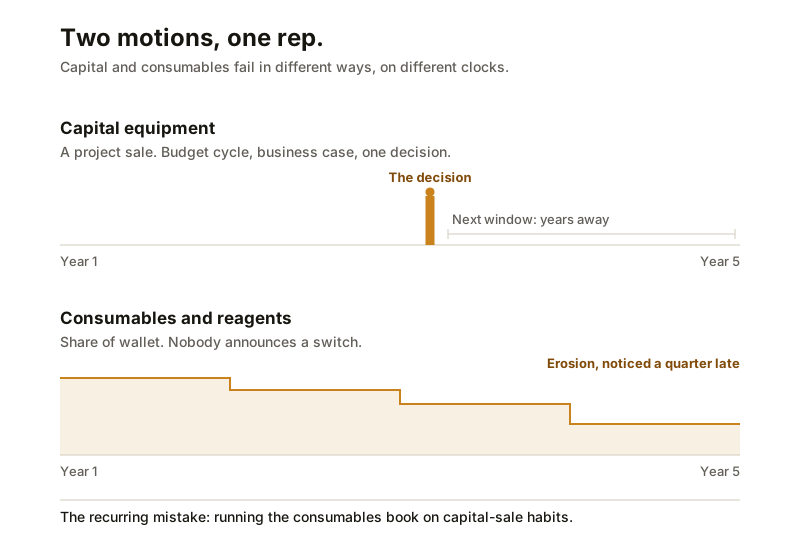
These need different rhythms. The recurring mistake is running the consumables book with capital-sale habits, checking in around quarter end and missing the drift entirely.
The installed base is the asset
An installed instrument is a standing relationship with a scientist who uses your product weekly. It is the best defensive position in the business and the most under-worked.
Two things follow. Displacement takes longer than a competitor's pitch suggests, so an account that looks lost often is not. And your own base is where your best expansion signals sit, if anyone is watching them.
What good enablement actually looks like
Most sales enablement in this industry produces more material for reps to read. Battlecards, decks, one-pagers, a portal nobody opens.
The reps I talk to do not have a content shortage. They have eight or ten systems, a territory of accounts they could each spend a week researching, and a few hours a week that are not admin.
Useful enablement is preparation the rep did not have to do. What changed at this account since the last conversation. Which programs are funded and scaling. What that implies for the products they carry. Delivered before the meeting, with the source attached so they can check it.
That is a different thing from content, and it is the part most tools businesses have not built.
Where to start
If I were tightening a tools commercial motion tomorrow, in this order:
Write down the account universe. Not the CRM export. The real list of organisations that could plausibly buy, by segment and scale.
Define what a trigger is for your products, specifically. "Series B raised" is not a trigger. "Series B raised by a cell therapy developer with no announced manufacturing partner" is.
Separate the capital and consumables motions, even if the same rep runs both.
Audit what your reps actually receive before a customer meeting, and ask whether it is preparation or homework.
Every one of those is a commercial excellence question rather than a technology question. That ordering matters, and it is the subject of the rest of this cluster.
Disclosure: LuminOne builds ARIA, a platform for life sciences commercial teams. This piece is drawn from my own operating experience rather than research, and you should read it with that interest in mind.