
How to Use AI in Life Sciences Sales: A Field Guide for Commercial Teams
A practical guide to AI in life sciences sales: five workflows worth automating, three to leave alone, how to measure it, and a 30-day starting plan.

Every commercial leader in life sciences has now sat through the same meeting. Someone shows a demo, everyone agrees it looks impressive, a pilot gets funded, and six months later nobody can say what changed. The tool is still paid for. Nobody opens it.
This guide is written for the problem underneath that pattern: how a commercial team at a CDMO, a bioprocessing equipment maker, a reagent supplier, or a consumables manufacturer gets real hours back and real pipeline out of AI, rather than another login.
I spent more than a decade in life sciences commercial roles before starting LuminOne. Most of what follows comes from watching good reps lose their week to work that no customer ever sees.
Figures below are current as of 25 July 2026, with the source and date given for each.
Start with the number that actually matters
Salesforce's 2026 State of Sales report, the seventh edition, surveyed more than 4,000 sales professionals and found sellers spend about 40% of their time actually selling. The other 60% goes to admin, CRM entry, internal meetings, hunting for the right deck, and chasing approvals.
For this industry the number is worse. When Salesforce announced Agentforce Life Sciences in May 2026, it cited field representatives spending up to 70% of their time on admin tasks. Regulated selling adds documentation and technical selling adds research, and both land on the rep.
Buying more tools has not fixed the tool problem. I wrote about why those saved hours rarely turn into selling hours in the 72% admin tax.
So the useful question is not which AI tool to buy. It is: what work disappears from a rep's calendar on Monday morning, and who checks that it did?
Why generic AI sales tools underperform in life sciences
Four structural reasons, all of which horizontal vendors ignore.
The buying committee is large, technical, and slow. Cycles run six to eighteen months with as many as nine stakeholders: procurement, CMC lead, regulatory, quality, process development, and a CSO who will not reply to anyone below VP. A tool built for a two-call software close has no model of this.
The signals that matter are scientific and regulatory, not firmographic. Generic intent data tells you a company visited a pricing page. It does not know that an IND filing gives a fill-finish CDMO roughly two quarters to get on the shortlist, or that a competitor's Phase 2 readout changes the urgency of a single-use assembly conversation.
Volume tactics burn the territory permanently. Cold email replies run at about 3.43% on average across Instantly's 2026 benchmark data, and a reply is not the same thing as interest. Round it generously and a thousand sends buys you a handful of real conversations. Where the addressable buyer list might be four hundred companies, spending it on a sequencing experiment is not recoverable. Your reps will see these people at BPI and INTERPHEX for the next decade.
The buyers are scientists. They read methods sections for a living. A message assembled from a template and a company name reads to them like a poorly controlled experiment.
The experiment that made the point
Zymewire, which sells sales intelligence into biopharma, ran a head-to-head in March 2024. A human BD director and ChatGPT were given the same press release, a Series A close at Attovia Therapeutics, and both wrote cold outreach from the perspective of a fictional small biologics CDMO.
The AI message congratulated the company, described the CDMO's capabilities, and asked for a meeting. Competent, polite, forgettable.
The human message gave away a real technical opinion instead: consider shifting from liquid to dehydrated cell culture media before scale-up because of the logistics burden, and check that any manufacturing partner holds multiple raw material suppliers so tech transfer does not stall. It had no call to action at all.
That test is two years old and the models have improved enormously since. What has not changed is the finding. The determining variable was not human against machine. It was the quality of the starting signal and the specificity of what went in. Two years of model progress has made the drafting better and has done nothing for teams whose input is still a company name and a job title.
The reframe: buy prepared work, not an assistant
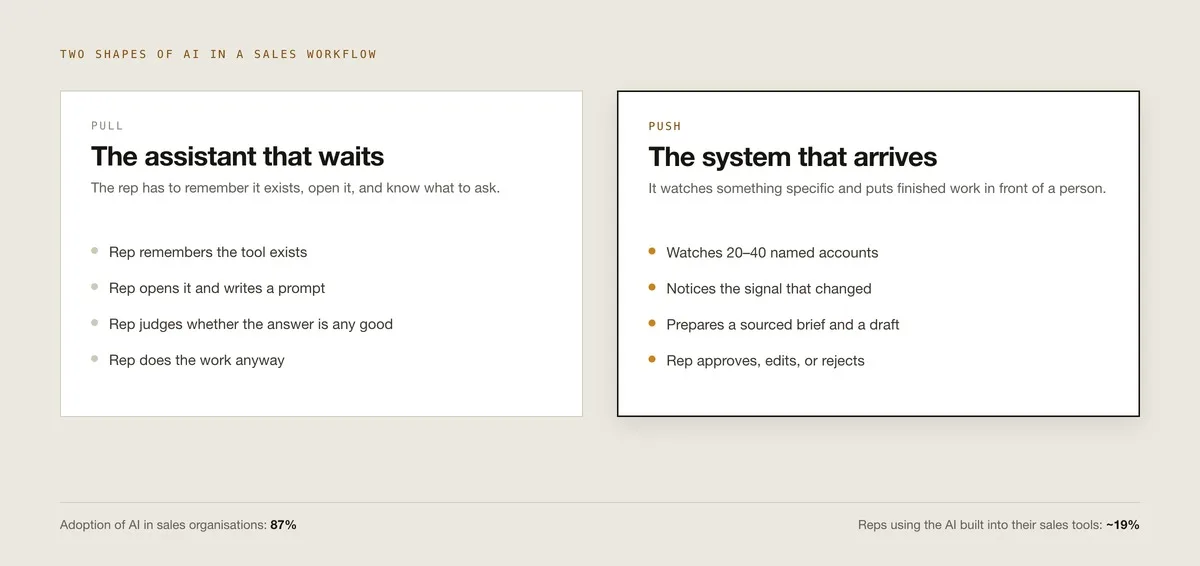
Nearly every AI sales tool on the market is a pull tool. It sits there. The rep has to remember it exists, open it, know what to ask, and know what a good answer looks like.
That explains a gap in the numbers. Salesforce's 2026 research puts AI adoption at 87% of sales organisations, using it for prospecting, forecasting, lead scoring, or drafting emails. Only 54% of sellers say they have actually used an agent. Buying it and using it are not the same event, and the distance between the two is the tool sitting there waiting to be opened.
The tools that change a rep's week are push tools. They watch something specific, notice when it changes, and put finished work in front of a person to approve. That difference is the whole argument for a reasoning layer rather than another assistant.
Sellers already seem to understand this. In the Salesforce 2026 data, 54% say they have used AI agents and nearly nine in ten plan to by 2027. Once agents are fully implemented, sellers expect prospect research time to drop by 34% and email drafting time by 36%.
Set that against Gartner's forecast that AI agents will outnumber sellers roughly ten to one by 2028, while fewer than 40% of sellers will say those agents improved their productivity. Both can be true. The gap between them is the gap between an assistant that waits and a system that arrives with the work already done.
Five workflows worth automating
1. Signal monitoring against a named account list
Not the whole market. Twenty to forty named accounts per territory, per rep.
What counts as a signal depends on what you sell:
- CDMOs: IND filings, Series A and B closes, phase transitions, CMC and MSAT hiring, facility announcements, program discontinuations inside existing clients, and CDMO switches by companies in your modality. More on this in AI for CDMO business development.
- Bioprocessing equipment: capital expansion announcements, onshoring commitments, capex language on earnings calls, and validation timelines at existing sites. See bioprocessing equipment commercial teams.
- Reagents and consumables: process development milestones, tech transfer announcements, scale-up from bench to pilot, new modality programs, QC method transfers, and analytical method validation activity. See reagent and consumables suppliers.
The funding picture makes precision more valuable, not less. Biotech venture funding rebounded through the first half of 2026. BioPharma Dive counted at least 68 companies raising more than $9.1 billion between January and June, the strongest first half since the start of 2022 among the companies backed by the 26 firms it tracks. J.P. Morgan's H1 2026 report puts biopharma venture funding at $16.3 billion across 235 rounds.
Read that as "the market is back" and you will target badly. The distribution is what matters. BioPharma Dive's own framing of the same data is that the startup funding gap widened even as investment rebounded: the money concentrated into fewer, larger, later-stage rounds while early-stage company formation lagged.
That pattern matches what I found reading a decade of SEC filings directly: the number of biotechs raising has held steady while the big rounds thinned out. For a BD team it translates the same way either route you get there. There is more money in the market and it is landing in fewer, larger, later-stage places. A rep working an alphabetical list will spend the quarter calling companies with no budget.
2. Read the order book, not the headline
The clearest recent example of why signal quality beats news consumption came four days before this was written.
Disclosure: I worked at Danaher and Cytiva earlier in my career. The analysis below uses only Danaher's own published results and call commentary.
Danaher reported Q2 2026 on 21 July. Revenue rose 5.5% to $6.3 billion, and the company raised full-year adjusted EPS guidance to $8.45 to $8.60. The stock closed down 11% that day, because a few large commercial customers pushed chromatography resin shipments out of 2026 and into 2027, and the near-term bioprocessing outlook was cut.
A rep who reads the headline concludes that bioprocessing demand is softening and deprioritises the segment.
A rep who reads the call learns close to the opposite. CEO Rainer Blair's own words in the release: "while customer project timing impacted bioprocessing revenue, underlying order trends remained strong and bioprocessing orders grew mid-teens in the quarter." Management described market inventory levels as considerably lower than in prior years and said they expect onshoring to accelerate. The revenue miss was shipment timing at a handful of named commercial manufacturers. The demand signal underneath it went up.
The market worked this out too, just late. The stock recovered 7.5% two days later, on 23 July, closing at 192.50 against 201.11 before the print. Anyone who deprioritised bioprocessing on the Tuesday headline had already been proven wrong by the Thursday close.
That distinction is worth a quarter of pipeline to anyone selling into biomanufacturing, and it lives in paragraph fourteen of an earnings call that no field rep has time to read. This is precisely the work to hand to a machine.
3. Pre-call research with a visible source trail
The deliverable is one page. What changed at this account in the last ninety days, who the people are, what your last three touches were, and what is plausibly on their mind this quarter.
One requirement is not negotiable: every claim carries its link. A rep will not put their credibility in front of a VP of Manufacturing on the strength of a summary they cannot check. Unsourced AI briefs are the most common reason these tools get abandoned in this industry, and abandonment happens the first time a hallucinated detail gets repeated out loud in a live meeting.
4. Drafted outreach tied to one specific event
The structure that works in biotech is narrow. Lead with the trigger, then one line on who you help and the outcome, then a soft ask. Forty to sixty words. Subject line of one to five words, and not the recipient's first name, which reads as automation on sight.
One benchmark fact is worth building into the workflow: 58% of all replies come from the first email in a sequence (Instantly, 2026). Your opener carries the campaign. Follow-ups are worth sending, but they will not rescue a weak first message, and in a market this small a weak first message is the expensive part.
Then do the thing the Zymewire experiment proved. Let the system draft, and have the rep add the one technical opinion that only a person with domain experience could offer. That sentence is what the buyer is evaluating.
5. CRM capture as a by-product of the conversation
Stop asking reps to write CRM notes. Have the system propose the update from the meeting and let the rep approve or correct it.
Approving takes forty seconds. Writing takes twenty minutes. Across a ten-person team with four customer meetings a day, that is most of a full-time equivalent recovered without hiring anyone.
There is a second benefit most teams miss. The difference between what the system drafted and what the rep changed is the richest training signal available anywhere in a commercial organisation. It is a record of judgement, captured to make people effective rather than to make them fill in a form.
What to leave alone
The first technical opinion. That is the product. Automating it removes the only reason a scientist replies.
Volume. In a market of four hundred addressable companies, volume is a liability with a compounding cost.
Approval. Anything leaving your domain should have a human name attached and a human who read it. Forrester's 2026 predictions, published October 2025, project B2B companies will lose more than $10 billion this year through ungoverned generative AI use. Most of that loss is reputational, and in a market this small, reputational damage is commercial damage.
RFP qualification. Cross-industry RFP win rates sit around 45%, with healthcare near 44% and top performers above 60%. Teams pursuing every RFP indiscriminately land in the 10 to 20% range, which is a qualification problem rather than a proposal-writing problem. AI is very good at helping a BD team decline faster and with better reasoning, which is worth more than helping them write more proposals they will lose.
This matters more in 2026 than it did last year. Alira Health's 2026 Biologics Contract Manufacturing Report, published 22 July, found the global biologics CDMO market reached $23.2 billion in 2025 and that competitive advantage is shifting from manufacturing scale toward specialised capability, regulatory sophistication, and modality-specific expertise. When differentiation is capability-based rather than capacity-based, chasing every RFP actively obscures the programs you are genuinely best placed to win.
How to measure it
Ignore transformation claims. Measure work created and work accepted.
| Metric | What it tells you |
|---|---|
| Useful signals surfaced per week | Whether the targeting is right |
| Approval rate on prepared actions | Your real quality score |
| Dormant accounts revived | Coverage you were not getting |
| CRM records updated without typing | Hours actually recovered |
| Time from signal to first touch | Whether speed improved |
Approval rate is the number to watch. If reps approve fewer than half of the prepared actions, the inputs are wrong, and adding volume will make things worse. Automating a broken process only produces bad emails faster.
A thirty-day starting plan
Week 1. Pick one territory and one motion. Nothing else. Have the rep list twenty to forty named accounts, including the installed base, not just prospects.
Week 2. Turn on signal monitoring only. No outreach at all. The rep marks each signal useful or not useful, daily. This is calibration, and skipping it is why most pilots fail.
Week 3. Allow drafted outreach, but only on the highest-scoring signals. Every draft gets human approval. Track approval rate.
Week 4. Compare replies, meetings booked, and hours spent on research against the same rep's previous quarter. Same rep, same territory, same product. That is the only honest comparison available.
Expand after that, one motion at a time.
Where ARIA fits
ARIA is the reasoning layer for life sciences commercial teams. It watches the market and your named accounts, works out what matters, and prepares sourced briefs, drafted outreach, and CRM updates for a person to approve.
Three commitments hold it together. Every claim carries its trail back to the original filing, release, transcript, or publication. Nothing leaves without a human saying yes. And it runs on the CRM and email you already have, with no stack change. If you want the honest comparison against general-purpose tools, I wrote that out here.
Test it the same way you would test anything else in this article. Bring twenty target accounts from one territory, or your installed base list. ARIA returns the signals that were missed, the source trail behind each one, an account readout, and prepared actions. Then judge it on approval rate. You can try it on your own account list without talking to anyone first.
A closing opinion
The prevailing pitch in this category is that AI will replace people. In life sciences that pitch fails, and it fails for a reason that has nothing to do with the technology. What your customers are buying is judgement about science, timelines, and risk. There is no way to buy that from a system, and no CMC lead is going to accept it from one.
What works is narrower and much more valuable. A good rep who walks into every meeting looking like they have a research team behind them, because they do.
Sources and dates. Salesforce State of Sales, 7th Edition (3 Feb 2026, n>4,000); Salesforce Agentforce Life Sciences announcement (19 May 2026); Gartner sales AI agent forecast (18 Nov 2025); Instantly Cold Email Benchmark Report 2026; Zymewire cold outreach head-to-head (Mar 2024, cited as a method result rather than current data); Danaher Q2 2026 results (21 Jul 2026), with share price moves from public market data (20-23 Jul 2026); BioPharma Dive H1 2026 venture funding analysis (13 Jul 2026); J.P. Morgan Biopharma and Medtech Deal Reports, Q2 2026 (16 Jul 2026); Alira Health 2026 Biologics Contract Manufacturing Report (22 Jul 2026); Corstrate CDMO RFP analysis (Jul 2026); Forrester 2026 B2B Predictions (Oct 2025).