 by LuminOneBook an introductory call ↗
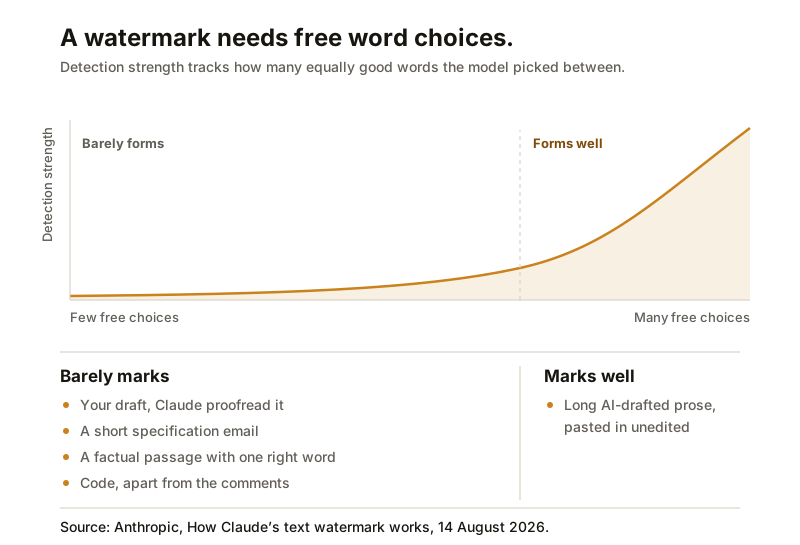
Anthropic's text watermark does not add anything to your text. It changes which word the model picks when several would work equally well, using a secret key, so that a pattern forms across a long enough passage. It carries no information about you or your company, and it barely forms at all on short factual writing.
That last point is the one that matters most for commercial teams selling into life sciences, and it is the one the argument online has largely missed.
What it actually is
When a model writes, it produces one word at a time. At many points several candidates are equally good. In Anthropic's own example, "the weather today was cold and" could reasonably continue with "overcast" or "grey," and the choice between them is settled by a random number.
Watermarking changes where that randomness comes from. Instead of an arbitrary random number generator, the model uses a key plus the preceding words to settle the choice. The words are still effectively random to a reader. But anyone holding the key can check the sequence and assign a probability that Claude produced it.
Anthropic describes the method as a version of SynthID-Text, published by Google DeepMind in Nature in 2024, and traces the family of approaches back to a 2022 proposal by Scott Aaronson.
The company's summary of the consequences is worth quoting directly, because most of what is circulating contradicts it:
Nothing is added to the text and there are no hidden characters.
That single sentence invalidates a large amount of advice being shared this month. Tools that strip invisible Unicode characters, zero-width spaces and the rest do nothing here, because the watermark is not made of characters. It is made of choices.
What it can and cannot prove
The watermark answers one question: what is the likelihood this was partly written by Claude?
It cannot confirm a human wrote something. It cannot tell you a different AI wrote it, since another model would use a different key and possibly a different method entirely. And in Anthropic's own words, it "cannot distinguish 'Claude wrote this' from 'Claude heavily edited this.'"
There is also no public detector yet. Anthropic says a detection API is coming and that it is "in the process of working out the details of its implementation." Until that ships, nobody outside Anthropic can check anything, which makes some of the current alarm premature.
Where it is weak, which is most of what a technical seller writes
Four limitations come straight from Anthropic's documentation, and together they describe an unusually large share of commercial writing in this industry.
Short passages. Detection needs many free choices to work with. Anthropic says it "doesn't work well on small samples," and confidence rises with length.
Factual passages. Where a different word would make the sentence wrong, there is no free choice for the watermark to use. Anthropic's example is that after "Isaac Newton's most famous work was called Principia," the next word has one correct answer, so the watermark has nothing to act on.
Proofreading. If a person writes the text and Claude corrects grammar and punctuation, nearly all the words are the person's. Anthropic says there is "very little (if anything) for the watermark to attach to."
Code. Exact output leaves no room for arbitrary word choice, so code carries less watermarking. What marking exists tends to sit in comments.
Now consider what a business development lead at a CDMO or a technical sales specialist at a consumables manufacturer actually produces. Short emails about a specific unit operation. Specification language where the terms are fixed. Capability statements built from approved boilerplate. Their own draft, tidied up. Every one of those sits in the weak zone.
Where the real exposure is
Long, AI-drafted prose pasted in verbatim.
That is the one case where all four weaknesses fall away at once: enough length, enough free word choices, and no human rewriting to dilute the pattern. In this segment the obvious candidate is a proposal or an RFI response, which is long, narrative, and often assembled under time pressure.
The practical line is not "avoid AI." It is that the exposure tracks how much of the final wording the model chose. Text the model produced end to end and nobody rewrote is checkable. Text a person wrote and the model cleaned up is largely not.
What this does not change
Ownership. Anthropic's Commercial Terms of Service state that the customer owns its Outputs, and assign Anthropic's right, title and interest in them, if any, to the customer. A watermark is a detection signal, not a claim on the work. It could not function as an ownership marker even if someone wanted it to, because it carries no identifying information at all.
Your data. The same terms state Anthropic may not train models on customer content from the services.
Files, which work differently. For a .png, .jpg or .svg, Claude attaches a C2PA content credential instead. That is signed metadata recording that the file was made or processed with Claude. Anthropic is explicit that this is "very different from a watermark," because nothing in the file itself changes. Metadata can be removed. The text watermark cannot be stripped, for the simple reason that there is nothing in the text to remove.
What I would do about it
Disclose on your own terms rather than waiting to be detected. In a market where the buyer is a scientist and the accuracy bar is closer to 99 percent than 95, being seen to use AI carefully is a smaller problem than being caught concealing it.
Write the words that carry a technical claim. Not because of the watermark, but because a specification a model produced and nobody checked is a commercial risk long before it is a compliance one.
And treat long AI-drafted documents as the case that needs a human pass. That was already true for accuracy. The watermark just adds a second reason.
Method and limitations
Every factual claim in this piece comes from Anthropic's own published documentation, principally How Claude's text watermark works (14 August 2026) and its Commercial Terms of Service, read directly rather than summarised from secondary coverage. Quotations are verbatim.
I have not independently tested detection, and I could not: no public detector exists yet. Claims about how well the watermark forms on short or factual text are Anthropic's own characterisation of its method, not measurements I have taken. The EU Code of Practice signatory count of roughly 190 is Anthropic's figure. Terms of service change, so check the current version before relying on the ownership language.
Disclosure: LuminOne builds ARIA, a platform for life sciences commercial teams that cites a source on every claim and says so when the evidence is thin. That is why provenance is a topic I follow closely, and you should read the above with that interest in mind.