 by LuminOneBook an introductory call ↗
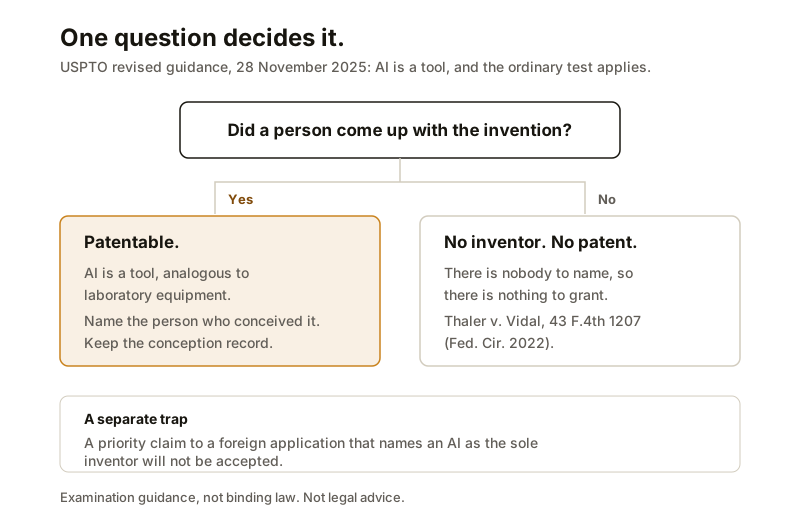
Using AI does not stop you patenting something. The USPTO rescinded its 2024 guidance in November 2025 and replaced it with a simpler position: AI is a tool, like laboratory equipment, and the ordinary conception test applies. What matters is whether a person conceived the invention, not whether software helped.
That is a more permissive answer than most of the commentary suggests, and it is worth knowing before your next sponsor conversation.
What actually changed
On 28 November 2025 the USPTO published Revised Inventorship Guidance for AI-Assisted Inventions. The document is short and unusually direct. It says the February 2024 guidance "is rescinded in its entirety," and that the approach relying on the Pannu joint-inventorship factors "is withdrawn."
The replacement rule reads:
AI systems, including generative AI and other computational models, are instruments used by human inventors. They are analogous to laboratory equipment, computer software, research databases, or any other tool that assists in the inventive process.
And it grounds that in settled principle, noting that inventors may "use the services, ideas, and aid of others" without those sources becoming co-inventors.
In other words, there is no longer a special AI test. There is the test that has always applied.
What the law requires
Two things, and they are separable.
An inventor must be a person. In Thaler v. Vidal, 43 F.4th 1207, 1212 (Fed. Cir. 2022), the Federal Circuit held that only a natural person may be listed as an inventor. The USPTO guidance restates it plainly: AI systems "regardless of their sophistication, cannot be named as inventors or joint inventors on a patent application as they are not natural persons."
A person must have conceived it. The Federal Circuit treats conception as "the touchstone of inventorship," defined as "the formation in the mind of the inventor, of a definite and permanent idea of the complete and operative invention, as it is hereafter to be applied in practice."
So the question a patent examiner asks about an AI-assisted invention is the same one they ask about any other. Did a person form that definite and permanent idea?
The case that actually fails
There is one, and it is narrow. If no human conceived the invention, there is no inventor to name, and no patent. That was the situation in Thaler, where the applicant claimed his system had conceived two inventions autonomously and listed the machine as inventor.
That is a real risk, but it is not the risk most people are worried about. Nobody is going to take your patent away because a model helped. The exposure is the scenario where you genuinely cannot point to a person who conceived the thing, and where your records cannot show it.
There is also a narrower trap worth knowing. The guidance states that "a priority claim to a foreign application that names an AI tool as the sole inventor will not be accepted." If your organisation files first in a jurisdiction that permits naming non-natural persons, a later US filing cannot claim priority from it. Applications claiming benefit or priority must name the same natural person, or share at least one natural-person joint inventor with the earlier filing.
Why this lands on commercial teams, not just legal
If you run business development at a CDMO or a CRO, or commercial at a tools or reagents manufacturer, this is not an abstract question for your patent counsel. It is a question your customers are starting to ask you.
Service organisations develop things on a sponsor's behalf. A process improvement during tech transfer. An assay method developed in a feasibility study. A formulation tweak that makes a difficult product manufacturable. Your master service agreement will say who owns that work.
What it probably does not say is what happens when AI assisted it. And a sponsor's IP counsel, reading the same headlines your team is reading, is going to ask.
The useful thing is that you now have a clear answer. AI is a tool. The work is inventorship-clean if a person conceived it and you can show that. What you need is not a policy against AI. It is a record.
What to actually do
Keep conception evidence, not just output. The thing the law asks about is what formed in a person's mind. Lab notebooks, dated design decisions, the reasoning behind a choice. If AI produced candidates and a scientist selected and refined one, the selection and refinement are the record that matters.
Do not let the AI question be answered ad hoc. When a sponsor asks whether AI touched the work, the worst answer is an inconsistent one from three different people. Decide the position once.
Check what your service agreements say now, before a sponsor asks. Most were drafted before this was a live question.
Do not over-correct into a ban. The current guidance is permissive, and a blanket prohibition on AI-assisted development costs you speed for a risk the USPTO has expressly declined to create.
Method and limitations
Every legal claim here is taken from the Federal Register text of the USPTO's revised guidance, published 28 November 2025 under document number 2025-21457, read in full rather than summarised from secondary coverage. Quotations are verbatim. The Thaler citation and holding are as stated in that document.
Two limits worth stating plainly. This is USPTO examination guidance, not binding law, and it implements a policy direction rather than a court ruling. Thaler remains binding Federal Circuit precedent on the narrow question of whether a machine can be named as inventor, but how courts will assess contested human contribution in heavily AI-assisted work has not been settled. And this covers United States practice only. Other jurisdictions have taken and may continue to take different positions.
I am not a lawyer and this is not legal advice. It is a commercial leader reading a primary source and telling you what it says. Any decision about a specific filing or a specific agreement belongs with your patent counsel.
Disclosure: LuminOne builds ARIA, a platform for life sciences commercial teams that cites a source on every claim and says so when the evidence is thin. Provenance and defensible claims are the problem I work on, which is why this topic caught my attention.