
The first 90 days after a CDMO acquisition are not just a CRM migration problem. They are a commercial-memory problem.
That is the part most acquisition announcements miss. The press release covers the strategic fit, the manufacturing footprint, the peptide or biologics capabilities, and the capital story. But customers experience the deal through account managers, program history, handoffs, responsiveness, and whether the new organization still understands the work already in motion.
When that commercial context breaks, the customer does not wait for integration to finish.
Key takeaways
- CDMO acquisitions create commercial risk before system integration is complete.
- The first 90 days are when customers watch for continuity: who owns the account, who knows the program history, and whether the new organization can respond without confusion.
- CRM migration is slow, but customer decisions are immediate. Parallel systems can become parallel realities.
- The most fragile asset in an acquisition is often not the plant, the process, or the pipeline. It is account knowledge distributed across people, notes, emails, and relationship history.
- Commercial teams need a way to preserve context across the old organizational boundary before customer trust starts to erode.
The press release covers the deal. Nothing covers the execution.
On May 27, 2026, CordenPharma announced that it had entered into an agreement to acquire AmbioPharm, a U.S.-headquartered peptide CDMO with facilities in South Carolina and China. The announcement emphasized expanded peptide API capacity, U.S. manufacturing capability, broader geographic reach, and combined peptide expertise. It also noted that AmbioPharm shareholders would reinvest in the combined organization. CordenPharma / PRNewswire
Nobody mentioned the commercial team.
That is normal. CDMO acquisition announcements almost always foreground science, capacity, assets, leadership, and capital. The operating reality that follows is less polished: two commercial organizations, two relationship maps, two CRM instances, two sets of account notes, and two cultures of account ownership being pushed together while customers keep making decisions.
CordenPharma/AmbioPharm sits inside a broader wave of life sciences manufacturing consolidation. Novo Holdings completed its acquisition of Catalent in December 2024. Catalent Syngene acquired its first U.S. biologics manufacturing facility from Emergent in March 2025. Syngene / PRNewswire Samsung Biologics announced a strategic acquisition of Human Genome Sciences from GSK in December 2025. Samsung Biologics / PRNewswire Sandoz completed its acquisition of Just-Evotec Biologics EU SAS in 2025. Sandoz
Each announcement has a strategic rationale. What is usually missing is a public answer to the operating questions commercial teams inherit immediately after close: who owns which customers, which CRM survives, how account context transfers, and how the combined organization keeps relationship history intact while systems are still being reconciled.
AVS Life Sciences has warned that life sciences M&A value is often lost in execution, citing research that 50% to 70% of transactions fail to realize projected synergies. The important point is not that life sciences companies choose the wrong targets. It is that post-close execution is where the deal model meets the operating system. AVS Life Sciences
The 90-day window is when customers decide
Customers do not wait for integration to complete before deciding whether the combined organization still feels stable.
In the first 90 days, buyers are watching for signals. Is my account manager still my account manager? Who do I call if there is a problem? Does the new organization understand my program history? Will the team try to migrate me to a new process before the project is done? Does anyone know the last technical concern we raised?
A CDMO sells relationships as much as it sells capacity. The knowledge of where a customer is in its development timeline, what its batch history looks like, what regulatory sensitivities are on the table, and which internal stakeholders actually shape procurement is rarely sitting neatly in one system.
It is distributed across account managers, CRM notes, email threads, meeting memory, technical handoff documents, and the head of whoever has carried the account for the last two years.
When two companies merge, that knowledge either transfers or it does not. Most of the time, it does not transfer fast enough.
What the systems data tells us
CRM consolidation timelines are not secrets. The benchmarks are public enough to be uncomfortable.
Pretius' guidance on CRM architecture after a merger or acquisition lays out three common paths: temporary reporting across CRMs, a "master CRM" model, and a master-data-management hub. It also notes that a full CRM migration typically takes 12 to 18 months, and that organizations without a hard consolidation deadline can remain in transition for three to five years. Pretius
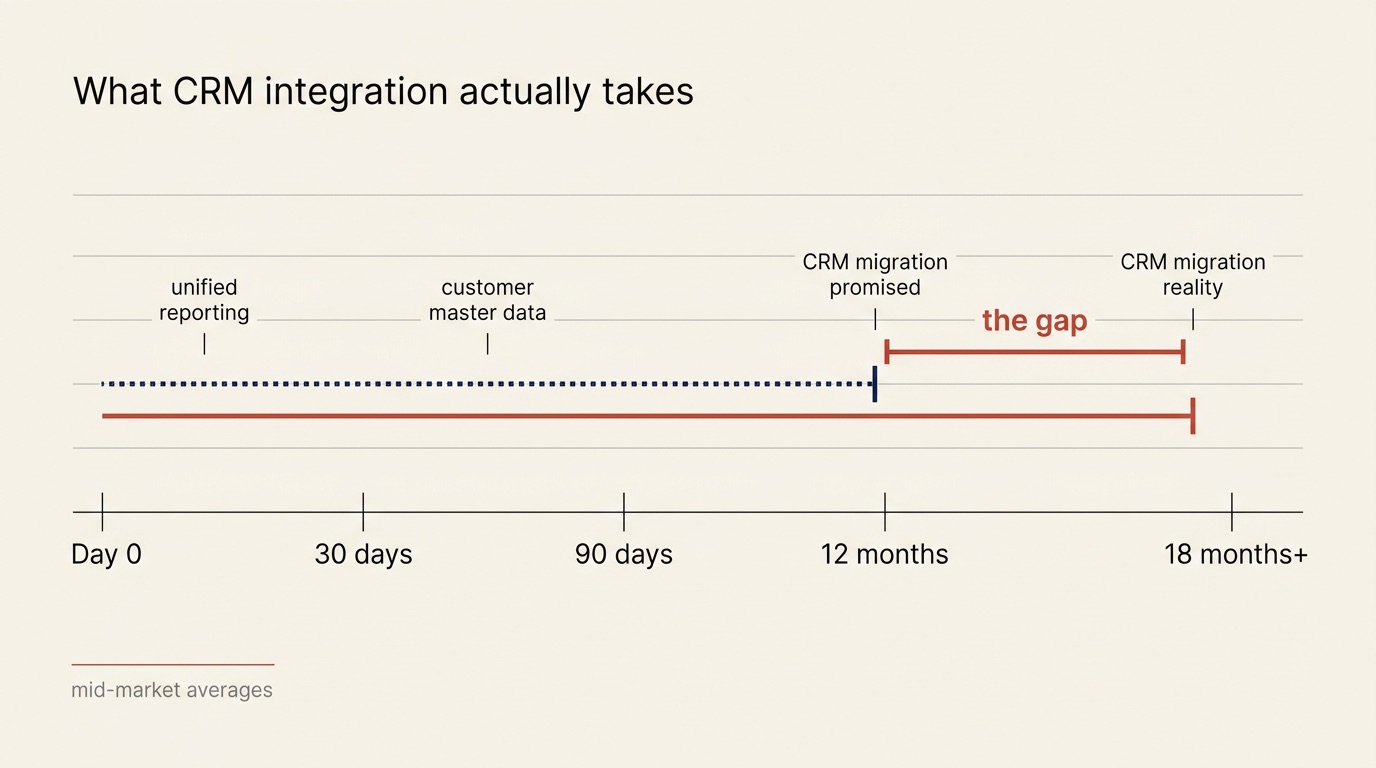
For a CDMO commercial team, parallel systems mean parallel realities. Account managers at the acquired company may not know what the acquirer's pipeline looks like. The acquirer's team may not understand relationship history at acquired accounts. Leadership may be looking at dashboards that do not reconcile. Customer service and business development may be operating from different versions of the account truth.
The commercial team is flying partially blind at the exact moment customers are deciding whether to stay.
The knowledge that does not survive the handoff
"Institutional knowledge" is too abstract a phrase to be useful. The real losses are specific.
What gets lost in a CDMO acquisition is the context behind a customer relationship: why a particular account manager was added to a program, what the sponsor's real constraint is, and which contacts influence procurement versus which ones simply sign paperwork.
What gets lost is the pattern of customer behavior over time: that this sponsor always needs a second technical discussion before authorizing a batch, that this program has had three timeline slips that were not the CDMO's fault, or that the customer's procurement window opens in Q3, not Q4.
What gets lost is the competitive landscape each account manager carries: who else is quoting on the program, what the customer has said about other CDMOs, where the relationship is strong, and where it is fragile.
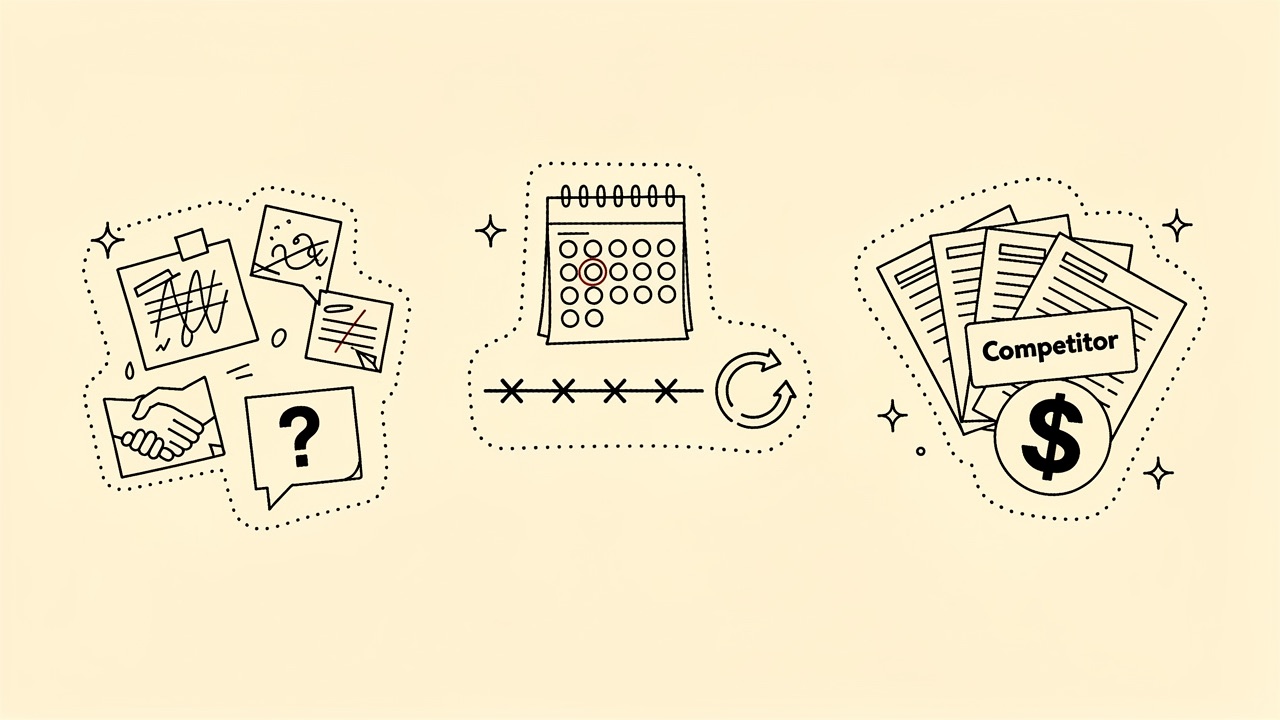
None of this is guaranteed to be in the CRM unless someone put it there. And most of the time, it is not in the CRM at the depth the next account owner needs.
Where the silo problem starts
The failure mode is not unique to CDMO M&A. It is a compressed version of the same problem inside every life sciences commercial organization: what one person learns does not automatically reach the people who need it.
Post-acquisition, that problem becomes more urgent. Two systems. Two relationship histories. Two institutional memories. Two teams trying to protect customers while the org chart, reporting model, and systems roadmap are still moving.
The commercial teams that come out of integrations intact are the ones that make distributed knowledge visible quickly across the old organizational boundary.
That is a systems problem. It usually does not get enough attention in the deal process itself.
What ARIA sees across acquisitions like this
ARIA is being built for this kind of environment.
The core problem is not automating CRM data entry. It is making sure that what one person in a commercial organization knows becomes accessible to the rest of the organization when it matters.
In an acquisition context, that means capturing account-level context before it walks out the door with the people who hold it, building a shared understanding of the customer base that does not depend on any single CRM surviving the integration, and giving the combined commercial team a way to stay coordinated while back-end systems are still being sorted out.
The 90-day post-acquisition window may be the hardest operating environment a commercial team faces. It is also one of the least tooled.
What I am watching in the CordenPharma deal
AmbioPharm's peptide expertise appears genuinely valuable to CordenPharma's customer base. The scientific fit is real. The combined organization also adds roughly 400 AmbioPharm employees to CordenPharma's approximately 3,000 employees, which is meaningful operating surface area to integrate. CordenPharma / PRNewswire
The announcement does not say how long integration will take, who will run the combined commercial function, which customer systems will survive, or how the combined customer portfolio will be managed during the first 90 days.
That silence is normal. It is also where the risk accumulates.
I will be watching this one. If you are at a CDMO that has been acquired, or you are at a sponsor company that is a customer of either organization, I would genuinely like to hear how the commercial handoff is going.
Sources
- CordenPharma / PRNewswire, CordenPharma Acquires AmbioPharm to Expand Global Peptide API Capacity
- AVS Life Sciences, Bridging the M&A Integration & Execution Gap in Life Sciences
- Pretius, CRM architecture after a merger or acquisition
- Catalent, Novo Holdings Completes Acquisition of Catalent
- Syngene / PRNewswire, Syngene Acquires its First Manufacturing Facility in the US
- Samsung Biologics / PRNewswire, Strategic Acquisition of Human Genome Sciences from GSK
- Sandoz, Strategic acquisition of Just-Evotec Biologics EU SAS
Building or evaluating commercial intelligence for a life sciences team going through integration? Learn more about ARIA or connect with Dhruv on LinkedIn.